Introduction
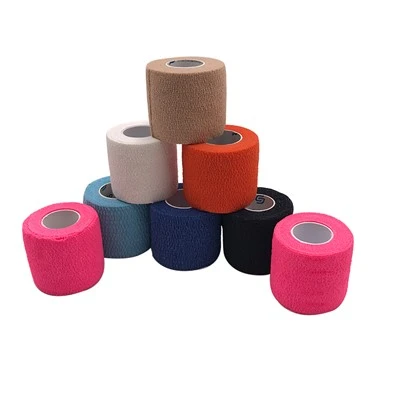
Kinesiology Tape is popular among athletes and fitness enthusiasts. Unlike traditional sports tape, it provides support and protection without restricting joint movement. As a professional Kinesiology Tape supplier, L WELL will detail how to properly use kinesiology tape for knee protection. Read on to learn more.
How Knee Sports Tape Protects Your Knees

• The elastic tape gently lifts the skin and subcutaneous tissues, improving blood and lymphatic circulation to reduce inflammation and swelling.
• When a joint is at risk of over-rotation, it provides appropriate resistance to prevent hyperextension and helps alleviate tendon inflammation around the knee.
• By stimulating the skin's surface, the tape enhances the brain's awareness of joint position and limb movement, aiding in knee stabilization.
Pre-Taping Preparations
Cleaning
First, use an alcohol wipe to gently clean the taping area, removing oils, sweat, or skincare products. These can reduce the tape's adhesion.
Hair Management
L WELL recommends trimming hair with an electric razor but avoiding a close shave. Newly shaved skin is sensitive and prone to irritation when the tape is removed.
Tape Cutting
Trim all edges of the tape into rounded corners. Sharp edges are more likely to peel. Prepare different tape shapes (I-strip, Y-strip, or X-strip), depending on the knee issue.
How to Put Kinesiology Tape on Knee for Different Problems
1. Knee Stability Support
For mild ligament laxity or sports protection, use the basic support taping method. It distributes axial pressure on the knee by providing longitudinal support.
• Measure the length from mid-thigh to mid-calf and cut an I-strip.
• Leave 3-5 cm at each end unstripped as anchors.
• Bend the knee to a 30-degree angle. Secure the thigh anchor first, apply slight tension, and smoothly adhere the tape down to the calf anchor.
• Finally, fix the calf anchor.
2. Patellar Tracking Disorder
Abnormal patellar (kneecap) tracking often causes anterior knee pain. A Y-strip is used to provide continuous corrective force.
• Fix the base of the tape below the tibial tuberosity.
• Gently push the patella toward the corrected direction (usually inward).
• Extend the two branches along the inner and outer sides of the patella, ending at the distal thigh.


3. Medial Collateral Ligament (MCL) Support
For MCL tension or mild injury, an I-strip is typically used. The straight tape reduces stress on the MCL during weight-bearing and rotational movements.
• Cut a longer I-strip.
• With the knee slightly bent, start from the distal inner thigh, applying greater tension over the MCL area.
• Continue diagonally across the inner knee, ending at the distal inner calf.
• Avoid stretching the anchor zones at both ends.
Conclusion
The above taping methods effectively stabilize your knee and provide extra support. They help you walk, climb stairs, or squat more comfortably.
LWELL - Your Leading Kinesiology Tape Supplier
As a professional medical tape and bandage supplier, L WELL offers high-quality products and taping training. Our pre-cut tapes include I, Y, X, and fan shapes, designed to protect different body parts. Contact us for a free product trial if interested.